

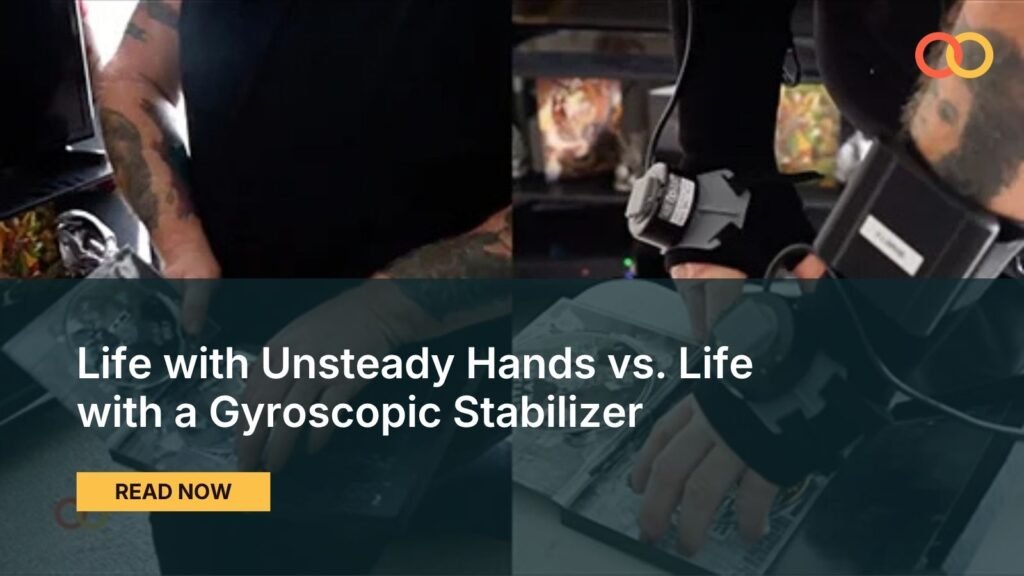
How Do Hand Tremors Affect Eating, Writing, and Social Confidence?
Hand tremors systematically erode the activities of daily living in ways that accumulate into profound loss of independence and social withdrawal. Specifically, the impact breaks down across three critical domains:
Eating and drinking are among the most immediately and visibly affected areas. Spilling drinks, scattering food from a fork, or being unable to bring a spoon steadily to the mouth in the presence of others creates intense embarrassment and anxiety — leading many people with Essential Tremor or Parkinson’s to avoid social meals, restaurants, and family gatherings altogether. For users of the GyroGlove, the restoration of stable eating is consistently the first and most emotionally significant improvement reported.
Writing and communication represent a second critical loss. Illegible handwriting — the inability to sign a document, write a card, or take a note — strips away a fundamental form of personal expression and creates practical barriers in professional and legal contexts. The GyroGlove’s fine motor dexterity support specifically addresses this use case, enabling the precise, controlled finger movements that handwriting requires.
Social confidence is the deepest and most pervasive impact of hand tremors. Research published in the journal Tremor and Other Hyperkinetic Movements has documented that individuals with Essential Tremor report significantly higher rates of social anxiety, depression, and isolation than the general population — with many withdrawing from public activities to avoid the visibility of their tremors. The act of regaining steady hands — even partially — restores the willingness to show up: to share a meal, attend an event, return to a hobby. For many users, this is the most transformative outcome of all.
Can a Wearable Tremor Stabilizer Replace Medication or Deep Brain Stimulation Surgery?
No — a wearable hand tremor stabilizer cannot replace medication or Deep Brain Stimulation (DBS) surgery as a neurological treatment, but it can meaningfully complement both — and in many cases, delay or reduce the need to escalate either. Specifically, for patients in the early-to-moderate stages of Essential Tremor or Parkinson’s Disease, a high-performing wearable stabilizer like the GyroGlove may provide sufficient functional improvement to postpone medication increases and their associated side effects, or to defer the serious decision about DBS surgery.
DBS surgery — which involves implanting electrodes into the thalamus to interrupt tremor-generating brain circuits — is a highly effective treatment for severe, medication-resistant tremors. However, it carries real surgical risks including infection, bleeding, stroke, and hardware complications. For patients who are not yet at the severity threshold that justifies surgical risk, the GyroGlove offers a compelling non-invasive bridge: immediate, daily functional improvement without anesthesia, recovery time, or surgical risk. As one neurologist at The NeuroMedical Center observed of anti-tremor devices broadly, they have “the potential to allow our patients to have a better quality of life in a non-invasive manner and relatively inexpensive way.”
What Is the Difference Between Active Tremor Suppression and Passive Tremor Dampening?
Active tremor suppression and passive tremor dampening are fundamentally different approaches to the same problem — and the distinction has meaningful consequences for real-world performance. Specifically:
Active tremor suppression (used by the GyroGlove) means the device generates a real-time counter-force that responds to each individual tremor event as it occurs. The gyroscope’s angular momentum provides an opposing force proportional to the tremor’s own energy — stronger tremors receive stronger suppression, weaker tremors receive proportionally lighter correction. The device never “misses” a tremor event because it is always active and always calibrated to the tremor in the current moment.
Passive tremor dampening (used by Steadi-3, Tremelo, and weighted orthotics) means the device relies on fixed physical properties — a magnetic disk of a certain mass, a tuned damper calibrated to an average tremor frequency, or weights calibrated at fitting — to absorb or oppose tremor energy. When the user’s tremors change in intensity, frequency, or direction, the passive device’s response remains the same. The practical consequence is reduced consistency: passive devices work well when tremors match the conditions under which the device was calibrated, but lose effectiveness when tremors fluctuate, intensify, or change character.
For users whose tremors are mild and highly consistent, passive dampening may be adequate. For users whose tremors are moderate-to-severe, variable, or unpredictable — the majority of people seeking a stabilizer — active gyroscopic suppression provides meaningfully more reliable daily performance.