

To make this process clear and practical, the following checklist is organized by patient profile. Find the profile that best describes you or the person you are helping, and use the recommended criteria as your starting point.
Choose a Tremor Glove for Parkinson’s vs Essential Tremor
The most important first step is understanding your tremor type, because different technologies are designed to address different movement patterns.
If You Have Parkinson’s Disease (Resting Tremor)
Parkinson’s tremor typically occurs when the hand is at rest and may decrease during intentional movement. It is usually slower (around 3–5 Hz) and more rhythmic.
- Passive devices such as weighted gloves or tuned mass dampers (optimized for higher-frequency tremors) tend to be less effective in this case.
- Devices that provide active stabilization, such as gyroscopic systems, can respond dynamically to changing tremor patterns instead of relying on a fixed frequency range.
In practice, many patients find that active wearable stabilizers offer more consistent support for Parkinson’s-related tremors, especially during transitions between rest and movement.
Other supportive options may include vibrotactile devices (e.g., Emma Watch), which aim to disrupt neurological tremor signaling rather than mechanically stabilize the hand.
If You Have Essential Tremor (Action or Postural Tremor)
Essential Tremor most often appears during movement or when holding a position (e.g., drinking from a cup or writing).
- This tremor typically falls within the 4–12 Hz frequency range, which aligns well with tuned mass damper devices.
- As a result, passive stabilization solutions (such as Tremelo or Steadi-3) can be effective for many users with mild-to-moderate symptoms.
However, active stabilization devices, including GyroGlove, may provide broader support—especially if tremor intensity varies throughout the day or across different tasks.
Choose a Tremor Device Based on Severity and Daily Impact
Beyond diagnosis, the severity of your tremor—and how much it affects daily life—is a key decision factor.
Mild Tremor (Occasional Difficulty with Fine Motor Tasks)
Examples: slight shaking when writing, occasional spilling
Recommended starting point: weighted or compression-based orthotic devices. These solutions are accessible and may provide enough stabilization for early-stage symptoms. If results are limited after consistent use, consider upgrading.
Moderate Tremor (Daily Functional Impact)
Examples: difficulty eating, drinking, or using a phone
Recommended starting point: tuned mass damper devices. These devices are designed to reduce tremor amplitude significantly and are suitable for extended daily use without charging. However, if tremor patterns are inconsistent or worsen over time, some users may benefit from exploring active stabilization technologies.
Severe Tremor (Loss of Independence in Key Tasks)
Examples: difficulty holding a cup, buttoning clothing, or signing a name
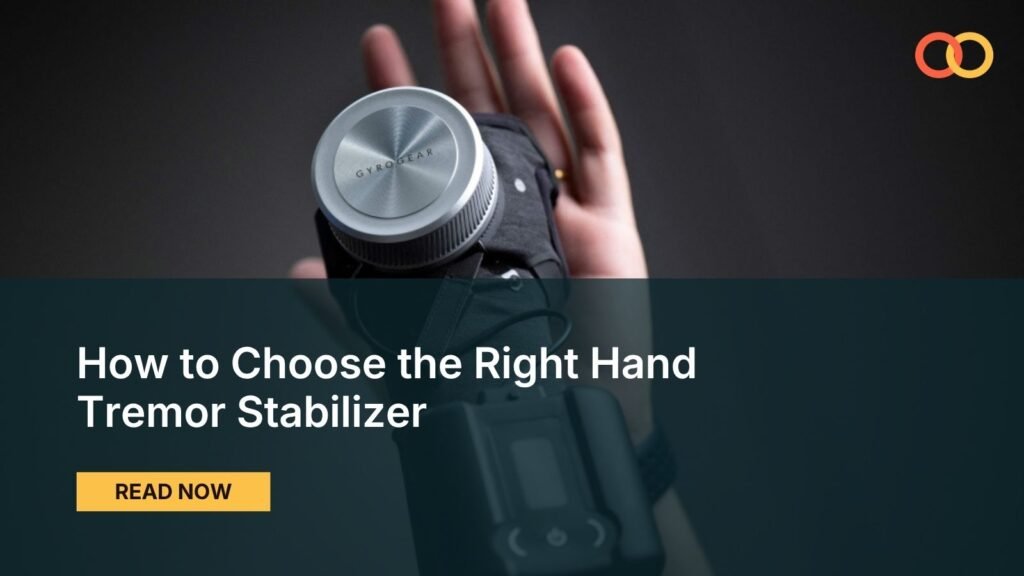
At this stage, GyroGlove’s active gyroscopic technology is the strongest available non-surgical option. GyroGlove offers a non-invasive and immediate way to reduce tremors, providing real-time assistance and potentially improving the quality of life for users without the side effects associated with drugs or the risks of surgery.
How Do Caregivers and Healthcare Providers Evaluate the Right Tremor Solution?
For caregivers selecting on behalf of a loved one
When choosing on behalf of someone else, the decision-making criteria often shift from pure performance to usability and practicality. Caregivers, for example, need to consider how easy the device is to put on and remove, especially for older adults who may have additional dexterity limitations beyond tremor. A device that is technically effective but difficult to use can quickly become impractical in real-world situations.
GyroGlove’s large buttons and clear display screen make it particularly well-suited for older adults who may have reduced dexterity beyond the tremor itself.
For healthcare providers considering a recommendation
Healthcare providers, on the other hand, tend to evaluate solutions through a clinical and evidence-based lens. Regulatory classification, availability of clinical data, and transparency in performance metrics all play a role in determining whether a device is appropriate for recommendation. Wearable tremor stabilization technologies are increasingly being studied in clinical environments, and devices that demonstrate measurable outcomes in controlled settings are more likely to be considered in professional care pathways.
GyroGlove is FDA-registed,and has an active multi-center clinical trial (NCT05958030) underway across US, UK, and Asian centers, and has published pilot study results from the International Neurology Congress 2023. It is the most clinically documented wearable tremor device currently available.
What Should You Look for in a Wearable Tremor Device Before Buying?
Before purchasing any hand tremor stabilizer, use the following checklist to evaluate whether the device truly matches your needs — and notice that the GyroGlove meets most of these criteria, particularly for moderate-to-severe tremor cases:
- Active vs. Passive mechanism: Does the device adapt dynamically to your tremors (active) or rely on a fixed response (passive)? Active is more effective for variable or moderate-to-severe tremors.
- Fine motor dexterity support: Does the device allow natural voluntary movement, or does it restrict the hand? Fine motor support is essential for writing, phone use, and personal care.
- All-day wearability: Is the device lightweight enough and comfortable enough to wear throughout a full day without causing fatigue?
- Prescription-free access: Can you purchase and use the device immediately, or do you need to navigate a clinical prescription process?
- Portability and discretion: Is the device compact and socially neutral enough for use in public, social, and professional settings?
- Evidence base: Has the device been evaluated in controlled studies or clinical settings? Does the manufacturer publish transparent performance data?
- Trial and return policy: Does the supplier offer a meaningful trial period so you can test the device risk-free before committing?
Key Takeaway
Choosing the right tremor solution is not just about the device itself—it’s about matching the technology to your condition, severity, and daily challenges. While passive devices can be effective for predictable, mild tremors, they often reach their limits as symptoms become more complex or disruptive to independence.
This is where newer generations of wearable stabilization technology—such as those developed by GyroGear—are reshaping expectations. By focusing on active, real-time motion control rather than fixed mechanical resistance, GyroGlove aims to address the gaps that traditional approaches cannot fully cover, particularly for individuals with moderate to severe tremors or variable movement patterns.
Rather than replacing all existing options, these technologies expand the decision landscape. For patients, caregivers, and clinicians, this means having access to a broader spectrum of solutions—from simple support to advanced stabilization—making it possible to choose an approach that not only reduces tremor, but also restores confidence and control in everyday life.