
What Is a Hand Tremor Stabilizer?
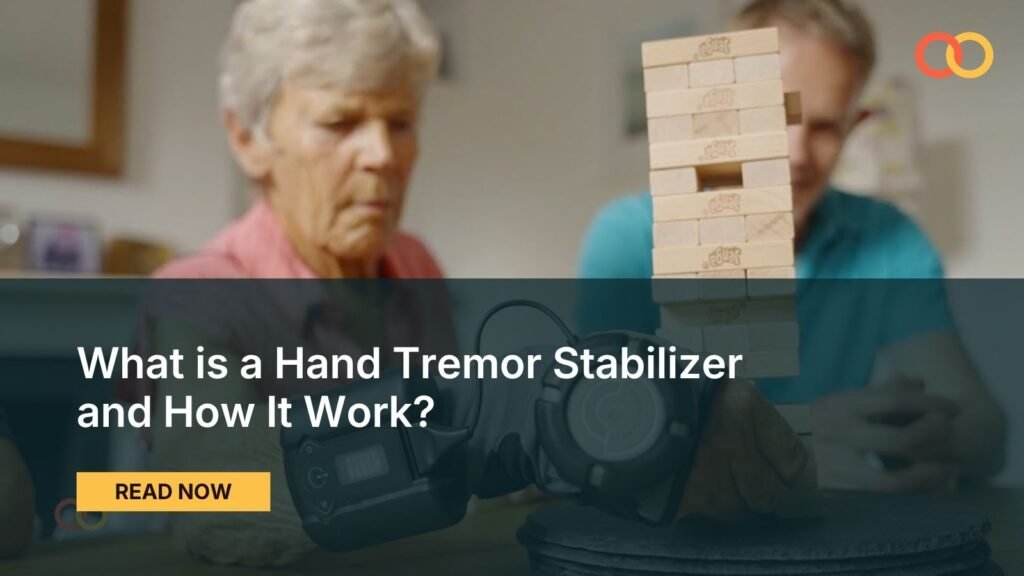
A hand tremor stabilizer is a wearable assistive device — worn on the hand, wrist, or forearm — that uses mechanical, gyroscopic, magnetic, or neurostimulation technology to reduce the amplitude of involuntary shaking, enabling more precise and controlled hand movement during daily activities. Crucially, the most effective stabilizers do not simply mask tremors by adding weight or resistance; instead, they actively counteract the tremor motion in real time, allowing the hand to move naturally and accurately. To understand which type of device is right for you, it helps to know what kinds of tremors exist and how different technologies respond to them.
What Conditions Cause Hand Tremors That a Stabilizer Can Address?
Hand tremors are most commonly caused by two neurological conditions: Essential Tremor (ET) and Parkinson’s Disease. Essential Tremor is the more prevalent of the two — the International Essential Tremor Foundation estimates it affects over 10 million Americans alone, making it eight times more common than Parkinson’s Disease. ET typically produces action tremors, meaning the shaking occurs when the person is actively using their hands — eating, writing, drinking, or holding objects. Parkinson’s Disease, by contrast, often presents as resting tremors that occur when the muscles are relaxed, though action tremors can also appear as the disease progresses.
Other conditions that can cause hand tremors addressable by stabilizers include Multiple Sclerosis (MS), cerebellar tremor from brain injury, dystonic tremor, and medication-induced tremor. Importantly, a hand tremor stabilizer does not treat or cure the underlying neurological condition — it reduces the physical expression of the tremor so that the user can perform tasks with greater precision and confidence. For this reason, gyroscopic stabilizers like the GyroGlove are particularly effective for action tremors, which are the primary type experienced during everyday functional tasks.
Is a Hand Tremor Stabilizer the Same as an Anti-Tremor Glove?
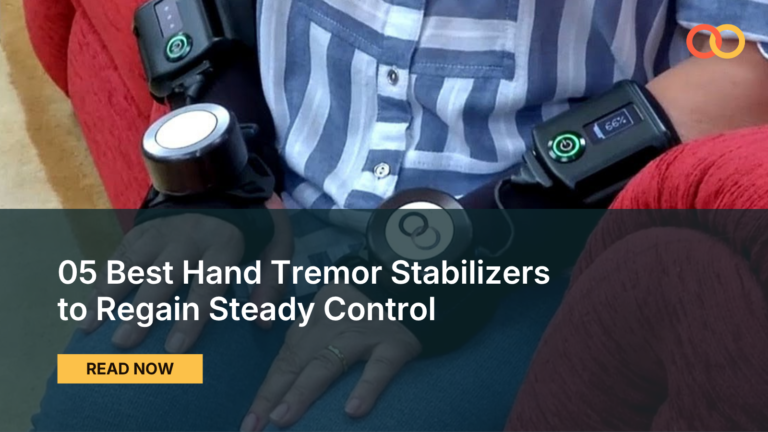
No — a hand tremor stabilizer is not the same as an anti-tremor glove, though the two terms are sometimes used interchangeably. There are four main categories of hand tremor devices, each using a different stabilization principle:
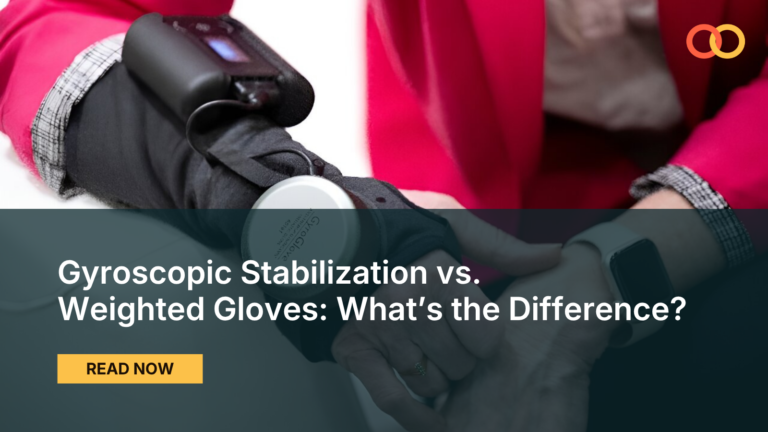
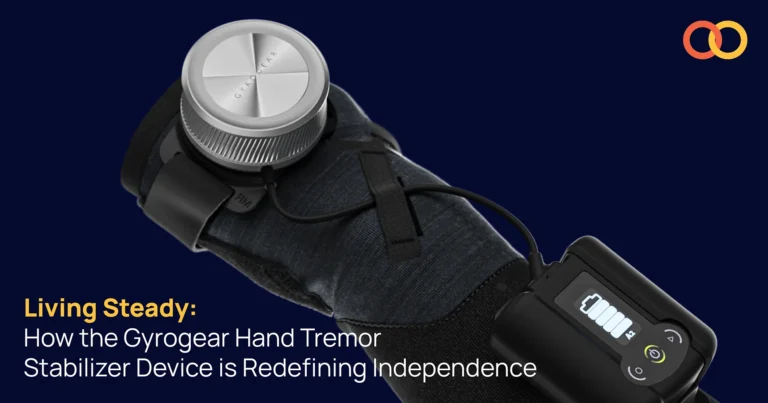
- Gyroscopic stabilizer (e.g., GyroGlove by Gyrogear): Uses a spinning gyroscope to generate angular momentum that actively resists sudden tremor movements — the most technologically advanced category, offering instant, adaptive stabilization.
- Magnetic vibration absorber / glove (e.g., Steadi-3 Plus by Steadiwear): Uses a passive magnetic disk that oscillates in opposition to the tremor — battery-free but reactive rather than proactive, best for mild tremors.
- Weighted orthotic / glove (e.g., Readi-Steadi): Adds calibrated weight to the back of the hand to dampen movement — effective in some cases but can cause fatigue with extended use.
- Tuned mass damper sleeve (e.g., Tremelo by Five Microns): Wraps around the forearm and uses a small internal mass that shakes against the tremor — a mechanical solution borrowed from civil engineering.
- Neurostimulation wristband (e.g., Cala kIQ): Delivers electrical stimulation to the peripheral nerves to disrupt tremor signals at their source — requires a physician prescription and is classified as an FDA-cleared medical therapy rather than a wearable consumer device.
In short, the term “anti-tremor glove” typically refers to passive or semi-passive devices, while the GyroGlove represents a fundamentally different — and more advanced — class of active stabilization technology.
How Do Wearable Hand Tremor Stabilizers Actually Work?
Wearable hand tremor stabilizers work through three primary technology groups — gyroscopic stabilization, passive mechanical dampening (magnetic or mass-based), and neurostimulation — each targeting tremor reduction at a different stage of the movement chain. Understanding how each mechanism operates makes it significantly easier to evaluate which device will deliver the most meaningful improvement in real-world use.
What Is Gyroscopic Stabilization and Why Is It the Most Advanced Tremor Control Technology?
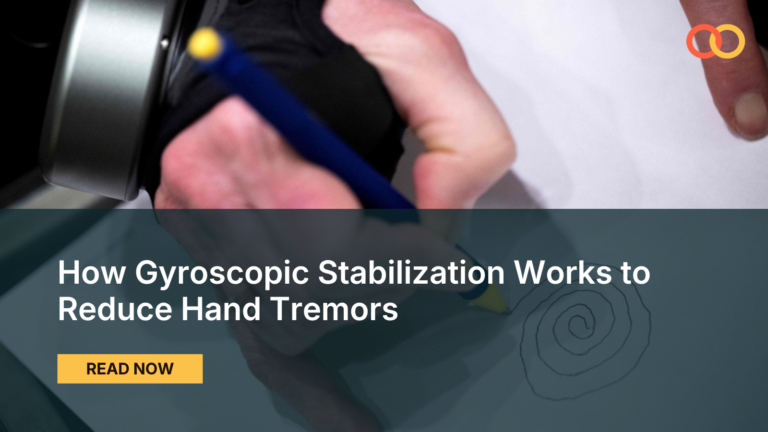
Gyroscopic stabilization is the most advanced active tremor control technology currently available in a wearable hand device, using the physics of angular momentum to instantaneously resist and counteract involuntary hand movements. At the core of the GyroGlove by Gyrogear is a precisely engineered gyroscope — a spinning disc that generates angular momentum when rotating at high speed. When the hand attempts to move involuntarily due to a tremor, the gyroscope resists that movement with a counter-force proportional to the tremor’s intensity and direction.
Specifically, this works like the noise-cancelling principle found in premium headphones: just as those devices produce a counter-sound wave to eliminate ambient noise, the gyroscopic mechanism produces a counter-motion to cancel out the tremor impulse — in milliseconds. The result is near-instantaneous stabilization that adapts dynamically to each individual tremor event, regardless of its amplitude or frequency. Unlike passive systems that rely on fixed physical properties, gyroscopic technology is active and adaptive, meaning it responds to what the tremor is doing right now — not just what it did on average.
Particularly relevant for users who need fine motor dexterity — the ability to use a phone, pick up a glass, or button a shirt — is that gyroscopic stabilization reduces tremor amplitude without rigidly locking the hand in place. The user retains natural voluntary movement while involuntary shaking is suppressed, a balance that passive devices struggle to achieve.
How Does Magnetic Vibration Absorption Work in Battery-Free Tremor Devices?
Magnetic vibration absorption, used by the Steadi-3 Plus by Steadiwear, works through a passive mechanical principle: a vibration disk inside the device moves in the opposite direction to the tremor, absorbing some of its energy and reducing the amplitude of hand shaking. Notably, this system requires no batteries and no electrical components, which makes it lightweight and maintenance-free — a genuine practical advantage for users who prefer simplicity.
However, there is an important limitation to this approach: because the mechanism is passive, it reacts to tremors with a fixed physical response rather than dynamically adjusting to changing tremor intensity. For users with mild, consistent tremors, this may be sufficient. In contrast, for users with moderate to severe tremors — or tremors that fluctuate throughout the day — the Steadi-3’s passive response may not provide consistent enough stabilization, particularly during high-demand tasks like eating soup or writing.
What Is Tuned Mass Damper Technology in Wearable Tremor Sleeves?
Tuned Mass Damper (TMD) technology, used by the Tremelo device from Five Microns, is a mechanical vibration control principle originally developed for large-scale civil engineering applications — the same physics used to stabilize skyscrapers during earthquakes and suspension bridges in high winds. Inside the Tremelo sleeve, a small internal mass is engineered to oscillate at the natural frequency of hand tremors, creating a counter-vibration that absorbs and dissipates tremor energy.
While this approach has demonstrated meaningful tremor reduction in clinical testing — Five Microns reports up to 85–90% tremor reduction in some users — the TMD mechanism carries practical trade-offs. Specifically, the device is worn as a sleeve around the forearm rather than on the hand itself, which can limit its effectiveness for fine-fingered tasks. Additionally, the bulk of the design, while functional, is less discreet than a glove or wristband, which may be a consideration for users in social or professional settings.
How Does Neurostimulation (TAPS) Compare to Wearable Mechanical Stabilizers?
The Cala kIQ uses Transcutaneous Afferent Patterned Stimulation (TAPS) — a form of non-invasive neurostimulation — to disrupt the brain’s tremor-generating neural circuits by delivering precisely timed electrical pulses through the skin of the wrist to the peripheral nerves. Clinically, the Cala kIQ is the only FDA-cleared wearable device for hand tremor therapy, and it is the only one in this comparison that requires a physician’s prescription.
However, this clinical positioning also introduces significant access barriers. Specifically, users cannot purchase the Cala kIQ directly — they must first consult a neurologist or movement disorder specialist who determines eligibility and completes the prescription forms. Insurance coverage (Medicare, VA, and select commercial plans) can reduce out-of-pocket costs, but navigating coverage takes time. In contrast, wearable mechanical stabilizers like the GyroGlove are available for direct purchase without a prescription, making them immediately accessible on the day a decision is made. For someone experiencing tremors who wants to improve their daily function today — not weeks from now — this is a decisive practical advantage.
RECOMMEND FOR YOU:
- How to Choose the Right Hand Tremor Stabilizer for Your Condition, Severity, and Daily Needs
- What Are the Best Hand Tremor Stabilizers to Regain Steady Control in 2026?
- Life with Unsteady Hands vs. Life with a Gyroscopic Stabilizer — What Really Changes?