

Many people reach a turning point when tremor moves from inconvenient to limiting. Writing becomes difficult enough to avoid. Meals in public become stressful. Work performance is affected. A first trip to the neurologist often happens not at the first sign of shaking, but months or years later — when the frustration crosses a threshold that no longer feels manageable alone. This article is for that moment: a clear, clinically grounded overview of what options actually exist and when each one makes sense.
How Is Essential Tremor Diagnosed: What Should You Expect at the Doctor’s Office?
Neurologists typically diagnose essential tremor through clinical examination rather than a single blood test or brain scan. According to Mayo Clinic, diagnosing essential tremor involves a review of your medical history, family history and symptoms, and a physical examination. There are no medical tests to diagnose essential tremor. Diagnosing it is often a matter of ruling out other conditions that could be causing symptoms.
In movement disorder clinics, one of the first observations is whether the tremor appears at rest or during action. This single distinction — resting versus action tremor — drives the differential diagnosis between Parkinson’s disease and essential tremor, and guides every subsequent treatment decision.
A typical first evaluation involves three components:
Neurological examination. Your neurologist will observe your tremor during specific tasks: holding your arms outstretched, reaching toward a target, pouring water between cups, drawing an Archimedes spiral on paper. The spiral drawing test is particularly informative — ET produces a characteristically rhythmic, symmetric distortion that differs visibly from Parkinson’s or dystonic tremor patterns.
Ruling out other causes. Blood and urine tests screen for thyroid dysfunction, metabolic abnormalities, and medication-induced tremor — all of which can produce shaking that resembles ET. Certain commonly prescribed drugs, including lithium, valproate, and some antidepressants, are known tremor contributors and need to be evaluated before an ET diagnosis is confirmed.
Dopamine transporter scan (DaTscan), when needed. If the clinical picture remains ambiguous — particularly when distinguishing early-stage Parkinson’s from ET is uncertain — a specialized neuroimaging study can reveal dopamine pathway integrity. Parkinson’s disease produces measurable changes in dopamine transport; essential tremor does not.
One practical step before your appointment: keep a brief log noting when tremor is most and least noticeable, which specific tasks it affects, whether stress or caffeine seems to amplify it, and whether any family members have had similar symptoms. This history is more clinically useful than most patients expect.
Read more: What Is Essential Tremor? Understanding the Causes of Uncontrollable Shaking
What Non-Pharmacological Strategies Help Manage Essential Tremor?
Non-pharmacological management is the recommended first intervention at any stage of ET — not because it replaces medication when medication is needed, but because it addresses function directly and remains valuable alongside every other treatment option.
Lifestyle modifications. Some tremor can be triggered by stress or strong emotion, being physically tired, or being in certain postures or making specific movements. Reducing caffeine, prioritizing sleep, and managing stress systematically can meaningfully reduce tremor amplitude without any medical intervention. These changes are not minor accommodations — for patients with mild tremor, they sometimes represent the difference between functional and symptomatic daily living.
Occupational therapy is one of the most underutilized resources for people with ET. Occupational therapy is a profession that helps people who have a disability, illness, or injury participate in occupations of everyday life — including bathing, dressing, eating, reading, gardening, driving, and cooking. An occupational therapist assesses which specific daily activities tremor affects most and builds a personalized strategy around them. This is considerably more effective than generic advice.
Adaptive equipment is a practical bridge between lifestyle modification and medical treatment. The IETF and published clinical literature recommend several categories of adaptive tools for ET patients:
- Weighted utensils: Adding mass to eating utensils can reduce visible tremor amplitude during meals. According to a peer-reviewed review published in Tremor and Other Hyperkinetic Movements (2024), simple weighted utensils add stability and may reduce the amplitude of tremors through added mass. Effectiveness varies between individuals, and trial-and-error with different weights is often necessary.
- Weighted pens and wrist weights: The IETF notes that weighted pens and pencils are commonly recommended. If weight works for you, consider wrist weights, weighted gloves, or universal weights that can be used on various utensils.
- Modified cups and containers: Travel mugs with lids, cups with wider bases, and straws reduce spilling without requiring fine motor precision.
- Voice-activated technology and adaptive software: For patients whose ET affects computer use or writing, voice-to-text software and adapted mouse settings significantly reduce functional limitations.
An occupational therapist is able to assist with concerns related to participation in daily activities, a physical therapist for concerns involving mobility or coordination, and a speech/language pathologist for concerns related to communication. Assistive devices can be specific to the person, daily activity, or task.
These are not last-resort measures. They are the clinical foundation that movement disorder specialists recommend before, during, and after any medication trial.
What Medications Are Used for Essential Tremor — and How Well Do They Actually Work?
Two medications have Level A evidence from the American Academy of Neurology (AAN) for essential tremor treatment: propranolol and primidone. Both are established first-line options and continue to be recommended by movement disorder specialists worldwide as the starting point for pharmacological management.
Propranolol (beta-blocker) works by reducing the peripheral component of tremor through adrenergic blockade. According to Johns Hopkins Medicine, propranolol blocks the stimulating action of neurotransmitters to calm trembling. This beta blocker is effective in 40% to 50% of patients and is less useful in reducing head and voice tremor. It is usually avoided in patients with asthma, emphysema, congestive heart failure or heart block, and should be used with caution by people with diabetes who are on insulin. Some patients use it situationally — a lower dose before a specific event — rather than daily.
Primidone (anticonvulsant) is often preferred in older adults and in patients for whom beta-blockers are contraindicated. According to Johns Hopkins Medicine, primidone controls the actions of neurotransmitters. It typically requires a slow dose titration starting at very low doses to minimize the sedation and dizziness that commonly occur with initial use.
For many patients, propranolol or primidone provide meaningful, sustained tremor reduction and remain their primary management strategy for years. The clinical picture is not uniformly discouraging: response rates vary, and individual patients often respond well to one medication even when they do not respond to the other. When first-line agents prove insufficient, neurologists may trial second-line options including topiramate, gabapentin, or benzodiazepines, though these carry more limited evidence and additional side effect considerations.
According to a 2024 review published in Medicina Clínica, only 30–60% of patients have a positive response to pharmacological treatment, and in those who do respond, the anti-tremor effectiveness is 40–60%. This variability is the clinical reality that drives interest in complementary approaches — not as a replacement for medication, but as an additional layer of management when pharmacological response is partial or incomplete.
When Is a Wearable Tremor Stabilizer the Right Addition to an ET Management Plan?
Wearable tremor stabilizers become a relevant consideration when essential tremor is affecting daily function despite lifestyle modifications — either as a complement to medication, as an alternative for patients who cannot tolerate pharmacological treatment, or as a primary tool for patients who prefer to avoid medication entirely.
Based on what people living with ET describe, the decision point is rarely dramatic. It typically comes when a specific activity can no longer be managed adaptively — when weighted utensils are not enough for eating independently in public, when medication has reached its ceiling effect, or when tremor begins affecting professional work or social engagement in ways that feel genuinely limiting.
In 2026, the peer-reviewed literature recognizes two distinct categories of wearable device for ET. A 2024 systematic review published in Tremor and Other Hyperkinetic Movements provides the most current clinical overview:
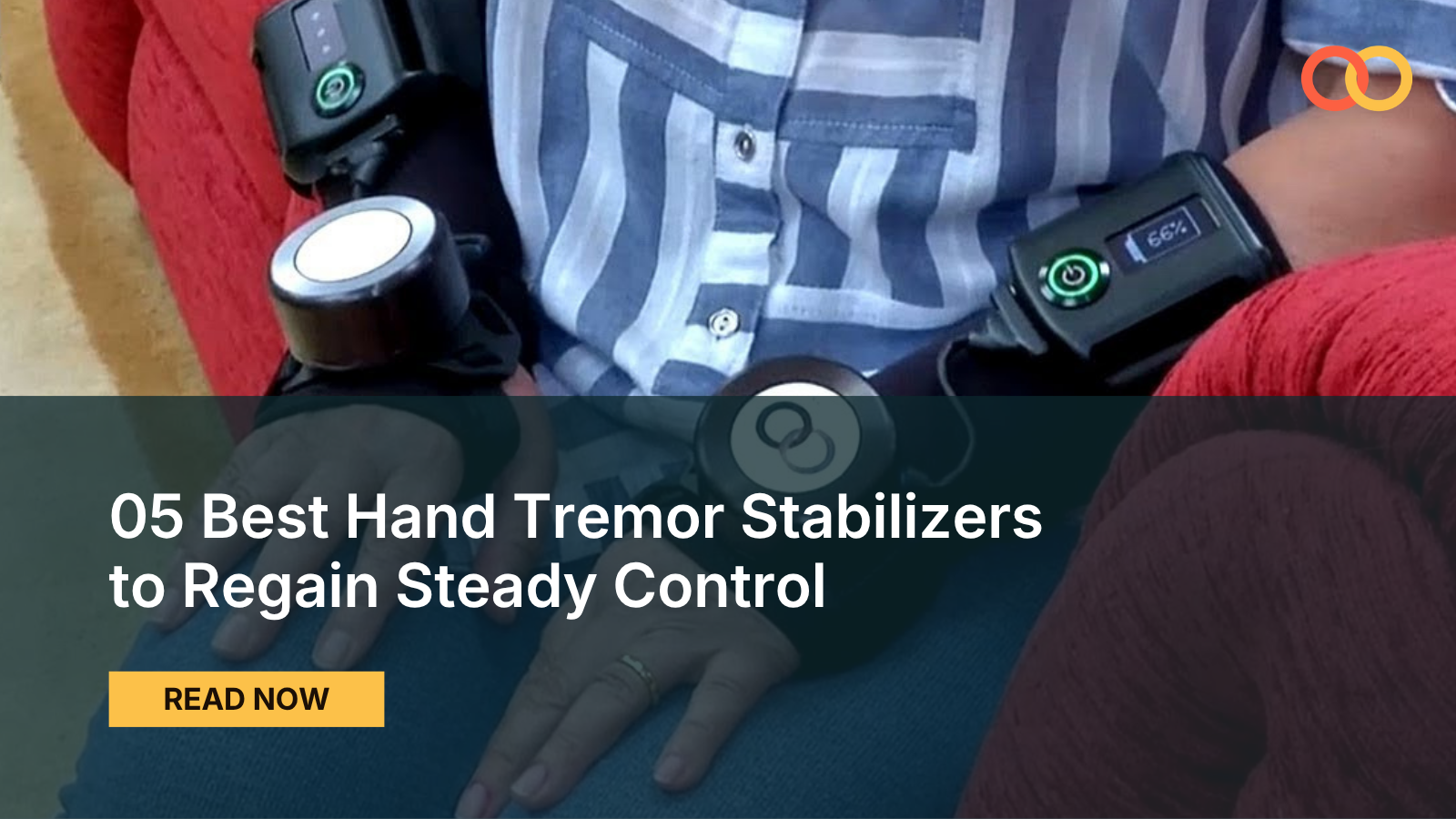
Mechanical/orthotic stabilizers work by applying a physical counter-force to the hand. Orthotic devices which physically dampen tremor include Tremulo™, GyroGlove™, WOTAS exoskeleton, Magnetorheological Fluid-Based Exoskeleton System, Steadi-One® and Steadi-Two®, and Readi-Steady®. Among these, GyroGlove by Gyrogear is designed for users who need continuous mechanical stabilization throughout the day rather than session-based symptom management — its active gyroscopic mechanism generates a real-time counter-force rather than passively dampening movement.
Peripheral nerve stimulation (PNS) devices work through a different mechanism — delivering targeted electrical signals through the wrist to modulate the brain circuits driving tremor. The PNS section discusses open loop (CALA-Trio) and closed loop systems (Felix™, NeuroAI™ and Motimove® systems). These devices are used in sessions rather than worn continuously, making them better suited to patients who want targeted relief before specific activities.
One important clinical caveat from the same peer-reviewed review: despite availability, most of these devices have limited to no published clinical trial data. This is an honest assessment of where the field currently stands. GyroGlove has published pilot study data from the International Neurology Congress 2023 and has an active multi-center clinical trial (NCT05958030) underway across US, UK, and Asian centers — making it among the better-documented options in the mechanical stabilizer category. However, head-to-head comparative trials between devices do not yet exist, and treatment decisions should be made with a movement disorder specialist who can weigh individual clinical factors.
The table below summarizes the main wearable categories for ET management, based on currently available clinical evidence.
| Category | Mechanism | Use Pattern | Evidence Level | Examples |
|---|---|---|---|---|
| Mechanical/gyroscopic | Active counter-force | Continuous wear | Pilot studies; clinical trial ongoing | GyroGlove |
| Tuned mass damper | Passive dampening | Continuous wear | Limited published data | Tremulo, Steadi-One |
| PNS — open loop | Nerve stimulation | Session-based | FDA-cleared; RCT published | Cala kIQ |
| PNS — closed loop (AI) | AI-driven nerve stimulation | Session-based | FDA-cleared 2025; RCT published | Felix NeuroAI |
| Weighted orthotic | Passive resistance | Task-specific | AOTA case series; IETF guidance | Readi-Steadi |
Does Essential Tremor Get Worse Over Time — and What Does That Mean for Treatment Planning?
Essential tremor is generally progressive — but “progressive” does not mean the same thing for everyone, and “benign” in the historical name does not mean mild forever.
According to NINDS, essential tremor can be mild and stay mild, or slowly get worse over time. For some patients, symptoms remain stable for many years. For others, particularly those with earlier onset or significant family history, tremor does progress to the point of meaningfully affecting work, social life, and self-care independence.
Essential tremor has a classically benign progression. However, it can be progressive and produce functional disability in some cases. The clinical implication is straightforward: treatment plans need periodic reassessment as the condition evolves. A management strategy appropriate at mild severity — lifestyle modifications plus adaptive tools — may need supplementation with medication or device-based approaches as tremor progresses.
This is also why the timing of intervention matters. Occupational therapy evaluation, medication trials, and device assessment are all more effective when initiated before tremor reaches severe functional impairment. Waiting until a patient can no longer perform basic self-care consistently narrows the options available and reduces treatment responsiveness.
There is currently no treatment that stops ET from progressing. What exists is a growing toolkit for managing its functional impact at each stage — and that toolkit has expanded meaningfully in 2026 compared to even five years ago.
For a detailed explanation of how gyroscopic stabilization technology works in GyroGlove, and how it differs mechanically from passive alternatives: How Gyroscopic Stabilization Cancels Shaky Hands: The Science Behind GyroGlove’s Active Tremor Control
For a full comparison of wearable tremor stabilizers with clinical evidence, pricing, and patient-profile matching: Best Hand Tremor Stabilizers 2026: Top 5 Wearable Devices Compared
Ready to discuss whether GyroGlove is appropriate for your specific situation? Contact us now!