

This helps explain why Parkinson’s tremor can behave differently from other motor symptoms such as slowness and rigidity, and why its response to dopamine-based treatment varies between people.
What Causes Tremor in Parkinson’s Disease?
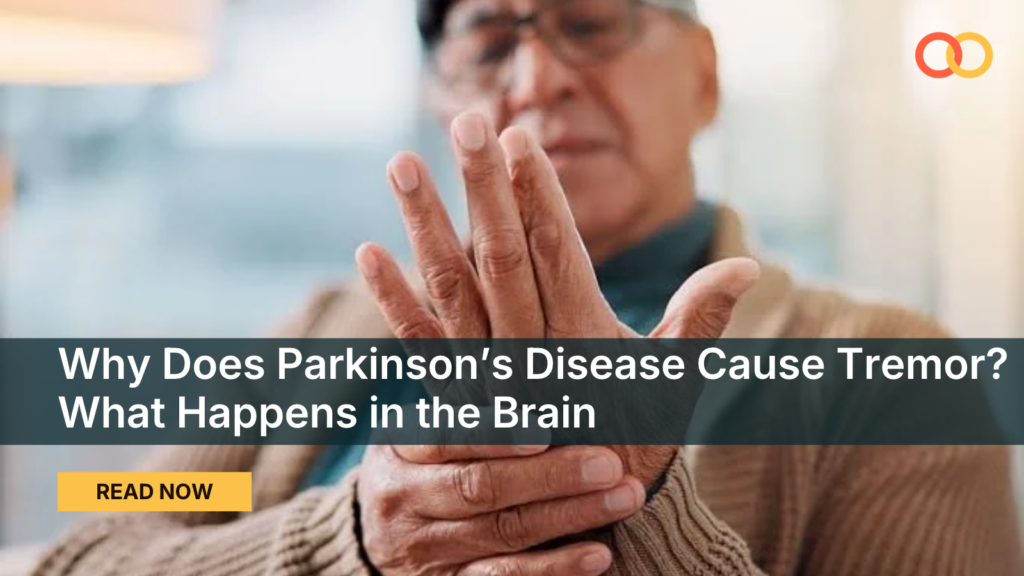
Parkinson’s disease damages dopamine-producing neurons in the substantia nigra, reducing the dopamine available to motor pathways in the striatum and basal ganglia. This changes how the brain selects, suppresses and coordinates movement.
For bradykinesia and rigidity, the relationship with dopamine loss is relatively direct. Tremor is more complicated.
Read more: Parkinson’s Tremor vs Dyskinesia: How Can the Movements Be Told Apart?
As dopaminergic control is lost, neurons within parts of the basal ganglia become more likely to fire in synchronized, rhythmic patterns. Research has identified increased tremor-frequency oscillations in structures including the subthalamic nucleus and globus pallidus. These abnormal rhythms interact with other motor networks and can eventually appear as the repetitive movement recognized clinically as Parkinson’s tremor.
The important point is that the final step does not occur in the basal ganglia alone. Dopamine loss helps create the conditions for tremor, but the visible shaking emerges from activity across a wider motor network.
What Role Does Dopamine Play in Parkinson’s Tremor?
Dopamine normally helps regulate signaling within the basal ganglia. In Parkinson’s disease, loss of this modulation changes the balance and timing of motor activity, making the system more susceptible to abnormal rhythmic oscillation.
A simplified sequence is:
loss of dopaminergic neurons → reduced dopamine in basal ganglia circuits → altered motor signaling → abnormal rhythmic activity across interconnected brain networks → tremor
This explains why dopaminergic medications such as levodopa often reduce Parkinson’s tremor. Restoring dopamine signaling can reduce the abnormal motor activity contributing to the shaking. However, tremor does not respond equally well in everyone, and some people continue to experience substantial tremor even when other symptoms improve.
Read more: Parkinson’s Tremor Treatment: What Can Reduce Shaking?
That variable response is an important clue to the underlying mechanism.
If tremor were simply a direct measure of dopamine deficiency, people with greater dopamine loss should consistently have more severe tremor, and restoring dopamine should control the shaking predictably. Parkinson’s tremor does not behave that neatly. Research instead supports a combination of dopamine-dependent and dopamine-independent mechanisms.
How Do Brain Networks Turn Dopamine Loss Into Tremor?
Parkinson’s tremor appears to emerge from abnormal interaction between the basal ganglia and a broader network involving the thalamus, motor cortex and cerebellum. There is no single “tremor center” responsible for the shaking.
The basal ganglia are important because dopamine loss changes their normal activity and can promote rhythmic oscillations. But those signals interact with additional motor pathways:
- the thalamus helps relay and synchronize motor signals;
- the motor cortex contributes to the final motor output;
- the cerebellar-thalamic network helps regulate timing and amplitude of movement.
Current models describe Parkinson’s tremor as a network phenomenon rather than the output of one damaged brain structure. A 2026 review similarly describes Parkinsonian tremor as increased pallidal and subthalamic oscillation combined with thalamocortical resonance following loss of dopaminergic modulation.
One influential explanation is the dimmer-switch model. In simplified terms, abnormal basal ganglia activity may act like a switch that helps initiate tremor, while cerebellar-thalamic circuits act more like a dimmer that influences how strongly the tremor is expressed.
Read more: Does Parkinson’s Tremor Come and Go? Why Shaking Can Change Throughout the Day
This network explanation helps make sense of several clinical observations: tremor can vary independently from bradykinesia and rigidity, its severity does not closely track dopamine loss in every person, and its response to levodopa can be incomplete.
It also creates an important distinction between changing the underlying Parkinson’s mechanism and supporting the function affected by tremor. GyroGear’s work focuses on the latter. GyroGlove™ is a wearable device designed to assist hand stabilization when tremor interferes with everyday hand use.
Read more: GyroGlove™ vs Medication and Surgery for Hand Tremors: What’s the Difference?
Parkinson’s tremor is therefore best viewed as a network symptom rather than a direct measure of dopamine loss. Dopamine depletion disrupts motor signaling, but the visible shaking emerges from abnormal rhythmic activity across interconnected brain circuits.