

The important distinction is that an aid does not have to eliminate tremor to be useful. In practice, the better question is whether it helps a person eat, write, dress or use technology with greater control and less effort.
For GyroGear, this functional perspective matters because two people with similar visible tremor can experience very different difficulties depending on the task, grip and movement pattern.
What Are Hand Tremor Aids and Devices?
Hand tremor aids and devices are tools that reduce the functional difficulty caused by shaking, either by modifying the task, improving grip or stability, or reducing the amount of precise hand control required.
They generally fall into four groups:
- Adaptive aids: modify an everyday object, such as a larger-handled utensil or pen.
- Task-stabilizing devices: help keep a specific object more stable during use.
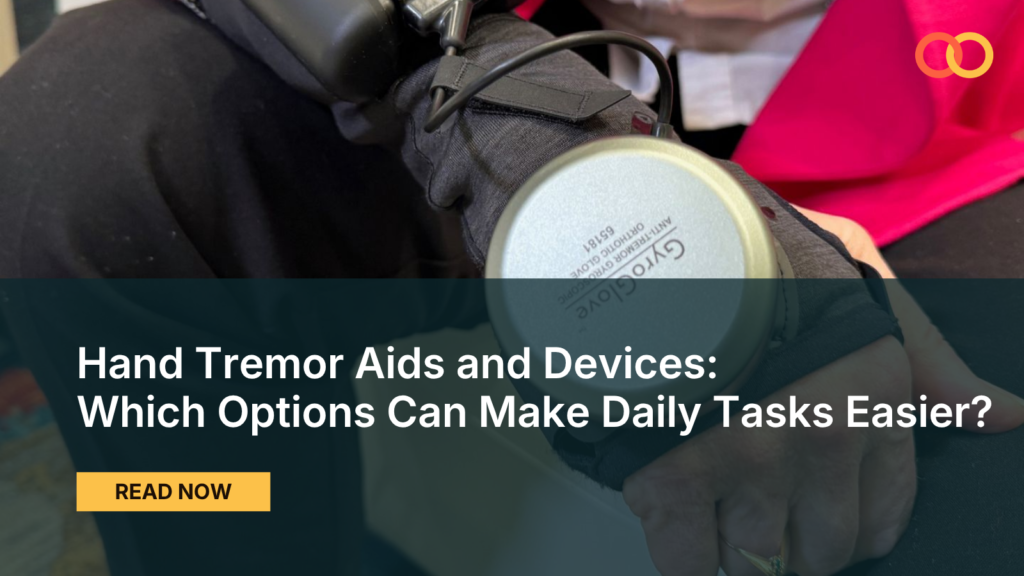
- Wearable devices: are worn on the hand or wrist and are designed to support hand stability or tremor-related function.
- Accessibility tools: reduce the need for precise hand movements, such as voice input or enlarged digital controls.
Occupational therapists may recommend adaptive equipment such as heavier utensils, wrist weights and wider writing tools for people whose tremor interferes with daily activities. Which category is most useful depends on what the person is trying to do, not simply how severe the tremor looks.
Read more: What Are the Best Hand Tremor Stabilizers to Regain Steady Control in 2026?
Which Hand Tremor Aids Can Help With Eating and Drinking?
Eating and drinking aids usually work by making objects easier to grip, reducing spilling or decreasing the precision required to move food and drinks.
Common options include larger-handled utensils, weighted utensils, stabilizing spoons, covered cups, two-handled cups, plate guards and non-slip surfaces. Adaptive eating tools can make meals easier when tremor or other movement difficulties affect utensil control, grip or stability.
Can Weighted or Larger-Handled Utensils Help?
They can help some people, but weighted utensils are not automatically better for every hand tremor.
A larger handle can reduce the grip precision needed to hold a fork or spoon. Added weight is sometimes used to improve control, although response varies between users.
However, more weight also increases the effort required to lift and control the utensil. Someone who already experiences weakness or fatigue may therefore find a heavily weighted utensil less practical.
The useful test is not whether the utensil feels heavier or looks more stable. It is whether the person can pick up food, bring it to the mouth and repeat the movement with less difficulty.
What Cups and Drinking Aids Can Reduce Spilling?
Cups that require less stabilization or protect against spills can make drinking easier when hand control is inconsistent.
Options may include:
- Cups with lids
- Cups with larger handles or two handles
- Half-filled cups to reduce weight and spilling
- Straws when appropriate
- Non-slip surfaces that prevent the cup from moving
Practical drinking adaptations may include partially filled cups, straws or other options that reduce the amount of control required during the task. The right setup depends on whether the main difficulty occurs while gripping the cup, lifting it or controlling it near the mouth.
Read more: Why Does My Hand Shake When Holding Something?
Which Aids Can Make Writing and Fine Motor Tasks Easier?
Writing aids can help by reducing grip demand, improving support or replacing handwriting when precise pen control becomes inefficient.
Useful options include wider pens, enlarged pen grips, supportive positioning and digital alternatives. Adaptive writing tools such as wider or heavier pens may help reduce grip demand or improve control for some people with essential tremor.
Can Pen Grips or Larger Pens Help?
Yes, particularly when excessive grip effort is contributing to difficulty.
A wider pen barrel or enlarged grip reduces how tightly the fingers need to close around the pen. Supporting the forearm on a stable surface may also reduce the amount of unsupported movement required during writing.
Weighted pens may help some people, but the same limitation applies as with weighted utensils: added weight can increase fatigue. The best pen is therefore not necessarily the heaviest one.
Writing should be evaluated according to both:
- Output: legibility and line control
- Effort: grip pressure, fatigue and how long writing can be sustained
A tool that produces slightly steadier handwriting but causes rapid fatigue may not be the better functional solution.
What Alternatives Can Help When Handwriting Is Difficult?
Sometimes the most effective aid is to reduce how much handwriting is required.
Options include:
- Keyboard input
- Voice-to-text
- Digital forms
- Styluses with larger grips
- Saved signatures or approved digital signing methods where appropriate
This is especially relevant for longer tasks. The functional objective may be completing the task reliably rather than preserving handwriting at all costs.
What Aids Can Help With Dressing and Grooming?
Dressing and grooming aids work mainly by reducing the need for small, precise finger movements.
Useful options may include:
- Button hooks
- Larger zipper pulls
- Easier fasteners
- Slip-on footwear
- Grooming tools with larger handles
Dressing adaptations may include hook-and-loop fasteners, button hooks, slip-on shoes and shoe horns when precise hand movements become difficult.
When a task consistently becomes difficult at one precise step, adapting that step may be more practical than trying to reduce the tremor itself.
What Can Help With Phones, Computers and Other Technology?
Digital accessibility features can reduce the precision required to operate phones and computers, sometimes without adding any physical device.
Options may include:
- Larger on-screen buttons
- Accessibility settings that change touch sensitivity
- Voice commands
- Voice typing
- Styluses with enlarged grips
- Phone or tablet stands
- Alternative keyboards or pointing devices
For some users, accessibility settings or voice input may solve the functional problem more effectively than adding another physical device.
How Are Stabilizing and Wearable Tremor Devices Different From Simple Aids?
Simple adaptive aids change the task or object, while stabilizing and wearable devices are designed to provide more direct support for movement or stability.
| Type | Main purpose | Example |
|---|---|---|
| Adaptive aid | Make an object easier to use | Larger utensil handle |
| Task-stabilizing device | Stabilize a specific object | Stabilizing spoon |
| Wearable device | Support tremor management while worn | Hand- or wrist-worn technology |
| Accessibility tool | Reduce precise hand input | Voice typing |
Some stabilizing utensils use active technology to compensate for movement during eating. Stabilizing utensils may help make scooping food and bringing it to the mouth easier for some users.
Wearable technology represents a different category again. Wearable peripheral nerve stimulation devices as an option for some people with essential tremor.
Do Tremor Devices Actually Stop the Tremor?
Not necessarily. Different devices are designed to achieve different outcomes.
Some aim to reduce tremor amplitude. Others stabilize one object or help the user complete a task despite ongoing tremor.
This distinction should be clear when comparing devices. A product that makes eating easier is not necessarily treating the underlying neurological condition, and a measurable reduction in tremor does not automatically mean every daily activity becomes easier.
Where Does GyroGlove Fit?
GyroGlove is a non-invasive wearable designed to support hand stability during selected everyday activities for appropriate users with hand tremor.
Unlike task-specific aids such as weighted utensils or pen grips, it is worn on the hand rather than built into a single object. This makes it more relevant when tremor affects several functional tasks rather than one isolated activity.
Its suitability should still be assessed according to the person’s tremor pattern, the activities affected and whether greater hand stability translates into easier task performance.
Read more: Gyroscopic Stabilization vs Weighted Gloves: What’s the Difference?
How Should You Choose a Hand Tremor Aid or Device?
Choose an aid according to the task that is difficult, the movement causing the difficulty and whether the device improves function without creating additional effort.
A practical assessment should answer five questions:
- Which task is difficult? Eating, writing, dressing and touchscreen use require different forms of hand control.
- When does the tremor interfere with the task? Tremor may become noticeable while holding a posture, during movement or only at particular points in the task.
- What is actually limiting performance? The main problem may be precision, grip, stability, weakness or fatigue.
- Does the device make the task easier overall? Added weight or complexity can sometimes solve one problem while creating another.
- Can the person use it consistently? A technically effective aid provides little practical value if it is uncomfortable, cumbersome or difficult to incorporate into daily life.
This is where GyroGear’s functional approach is particularly relevant. A device that reduces visible shaking is not automatically the best aid. The more meaningful outcome is whether the person can perform the activity more safely, accurately or with less effort.
When Is Occupational Therapy Helpful for Choosing Tremor Aids?
Occupational therapy can be useful when tremor interferes with several activities or when it is unclear which adaptation best matches the functional problem.
An occupational therapist can observe the complete task rather than focusing only on the shaking. This may include assessing:
- Grip and hand position
- Task setup
- Fatigue
- Safety and equipment fit
Occupational therapy can help adapt daily activities and identify assistive devices that better match the person’s functional needs.
Trial during the actual task is often more informative than selecting an aid from specifications alone, because added weight, grip size or stabilization may help one user but increase fatigue or difficulty for another.
Read more: How to Choose the Right Hand Tremor Stabilizer for Your Condition, Severity, and Daily Needs
Can an Aid Still Be Useful If the Tremor Does Not Improve?
Yes. Functional improvement does not require complete tremor reduction.
An aid can still be valuable if it results in:
- Less spilling
- Easier grip
- More legible writing
- Lower effort
- Safer task completion
- Greater ability to complete the activity independently
The best hand tremor aid is not necessarily the device that produces the greatest stabilization. It is the option that matches the person’s tremor pattern, the specific task and the functional problem that needs to be solved.
This article is for educational purposes only and does not replace professional medical advice, diagnosis or treatment.